
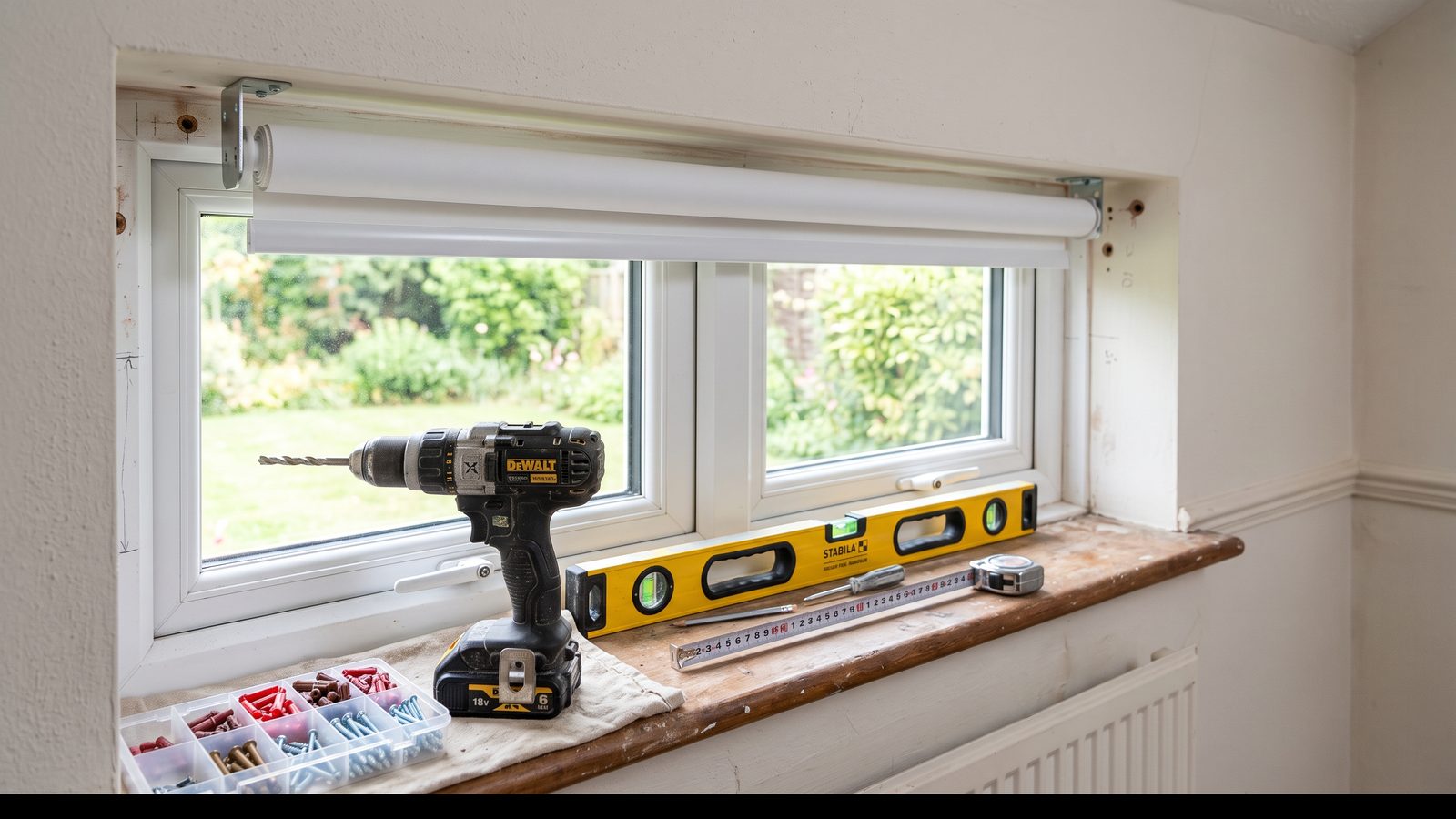
A blind installer measures the opening, orders the blind to that exact size, and fixes it
so it hangs level and clears everything around it. The measuring is the part that decides whether the
job works: a reveal is rarely square, so the installer measures the width in three places and uses the
narrowest, which is why a professional measure takes about 20 minutes per room and a made-to-measure
blind then takes 7 to 14 working days to manufacture.
The Job, Stage by Stage
| Stage | What the installer actually does | Typical time |
|---|---|---|
| Survey | Checks the reveal depth, what the wall is made of, which way the window opens, and where the stack will sit | 10–20 min per room |
| Measure | Width in three places and drop in three places; takes the narrowest width and the longest drop | 2–5 min per window |
| Specify | Chooses inside or outside mount, control side, chain length and child-safety device | On site |
| Manufacture | Blind is cut and assembled to the measured size | 7–14 working days |
| Fit | Marks and drills the brackets, levels the headrail, hangs and tensions the blind | 15–30 min per window |
| Hand over | Tests the full travel, fixes the safety device to the wall, cleans up | 5 min per window |
Measuring Is Where the Job Is Won or Lost
Almost every badly fitting blind is a measuring error, not a manufacturing one. An installer
measures the width at the top, middle and bottom of the reveal and works to the smallest of the three,
because a blind cut to the widest measurement will jam on the way down. The drop is measured in three
places for the same reason. On an inside mount the installer also checks the reveal is deep enough for
the headrail to sit fully inside it; on an outside mount they check there is enough flat wall above
the window to take the brackets. See how to measure for blinds
for the method in full.
What Gets Checked Before Anything Is Drilled
- What the wall is — brick, plaster, tile, aluminium or timber each take a different fixing.
- What is behind it — pipework and cabling above a window are common and expensive to hit.
- Whether the frame is plumb — an out-of-plumb frame means the headrail is levelled to the eye, not to the frame.
- Where the handle and stack land — the blind must clear the window handle and the door travel.
- Child safety — the chain tensioner is fixed to the wall as part of the fit, not left loose. See blind cord safety.
Slat and Fabric Decisions the Installer Makes With You
Slat width changes both the view and the stack height: 25 mm is the standard aluminium slat,
50 mm the standard timber and faux-wood slat, and 63 mm the wide option for large windows
(slat widths compared). On roller blinds the choice is the
fabric’s openness — a 3% sunscreen keeps a usable view while blocking most of the glare, a 10%
fabric is far more transparent (openness factor explained).
Repairs a Blind Installer Handles
Most faults are a part, not a new blind. Installers restring roman and venetian blinds, re-tape
venetian slats, replace worn clutches and chains, re-mechanise rollers and swap motors
(blind parts and spares). A blind that telescopes to one side
is usually a tube or bracket alignment fault rather than a fabric fault
(common blind problems).
What to Ask Before You Book One
- Do you measure on site, or do I supply the sizes? (If you supply them, the sizes are your risk.)
- Is the measure and quote free, and is the quote firm afterwards?
- Will you fit blinds I bought elsewhere?
- Is a child-safety device included and fixed to the wall?
- What is guaranteed — the blind, the fitting, or both?
Booking an Installer
Window Blinds Cape Town measures, manufactures and installs across the metro.
See blind installation for what a fit costs and includes,
blind repairs for existing blinds, and
what blinds cost for pricing.
Free on-site measure and quote — call 081 411 8471 or WhatsApp us.
Areas We Install In
Bellville, Bloubergstrand, Bothasig, Brackenfell, Century City, Claremont, Durbanville, Edgemead, Goodwood, Kraaifontein, Milnerton, Montague Gardens, Monte Vista, Observatory, Parow, Pinelands, Plattekloof, Salt River, Table View. Not sure if we cover your street? Call — we serve the Northern Suburbs and the wider metro.
Frequently Asked Questions
What does a blind installer do?
A blind installer surveys and measures the window, specifies the blind and its mount, then fixes the
brackets, levels the headrail and hangs the blind. Most also repair blinds: restringing, re-taping and
replacing clutches, chains and motors.
How long does blind installation take?
Fitting takes about 15 to 30 minutes per window once the blind has been manufactured. The measure
happens first and takes 10 to 20 minutes per room; manufacture is 7 to 14 working days in between.
Do I need an installer, or can I fit blinds myself?
Not always. A single blind on a square timber reveal is a realistic DIY job. Installers earn their fee on
out-of-plumb frames, tiled or aluminium surrounds, wide spans that need splitting, and anything above
comfortable ladder height.
Can an installer fit blinds I bought somewhere else?
Yes. Fit-only is a normal service, but the sizes are then your responsibility — a blind
measured wrong cannot be made to fit on site.