
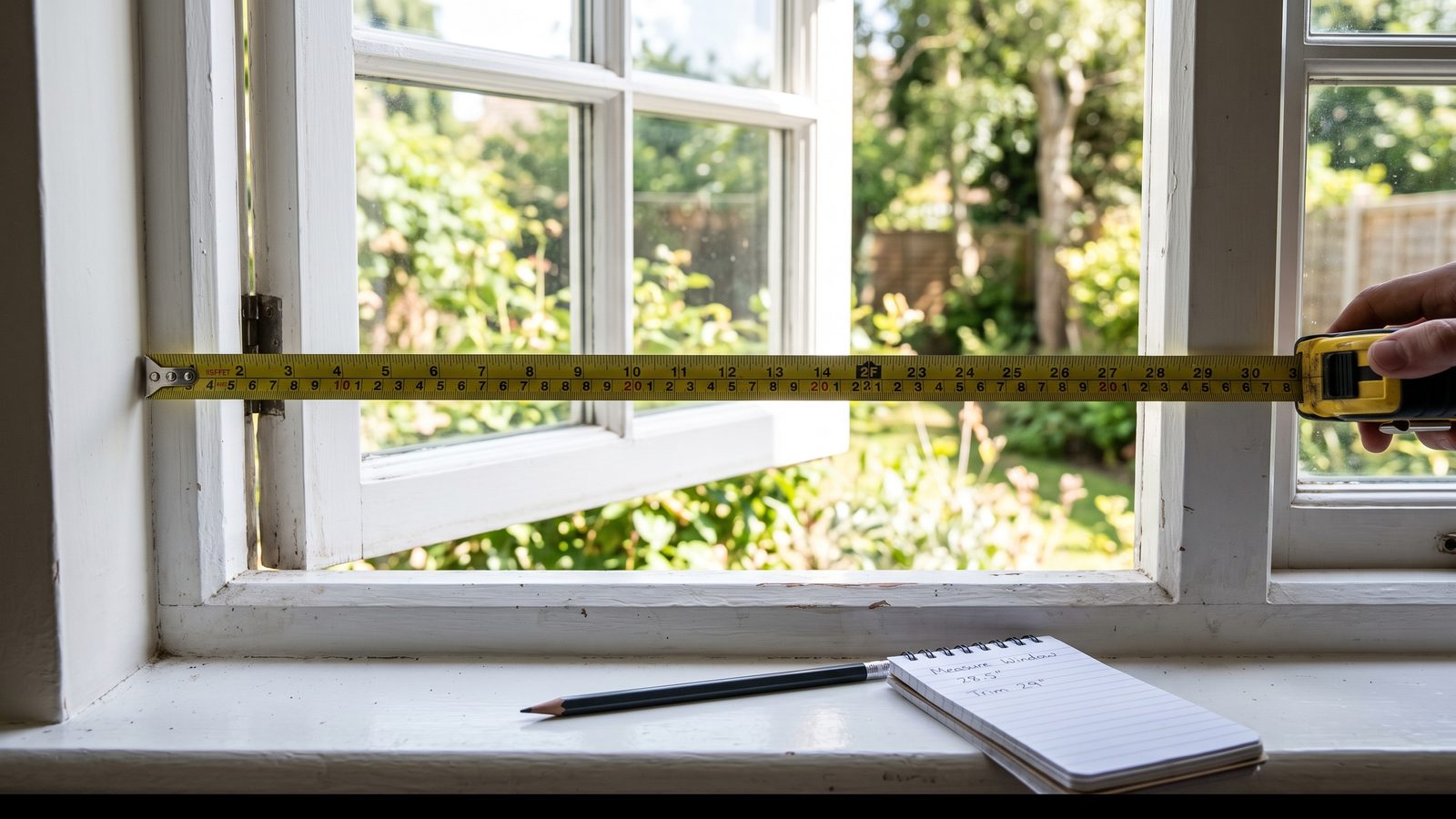
Measure the window opening in three places and use the smallest figure for a recess fit, or add 70–100 mm of overlap each side for a face fit. Measure in millimetres, never centimetres, and never deduct anything yourself — the manufacturer makes the deduction.
An installer measures the same way, on site: what a blind installer does.
Recess Fit or Face Fit
Every blind is made to one of two mounting decisions, and the measurement changes completely between them.
| Recess (inside) fit | Face (outside) fit | |
|---|---|---|
| Where it sits | Inside the window reveal | On the wall or frame above the opening |
| Width measured | Narrowest of three points | Opening + 70–100 mm each side |
| Drop measured | Reveal top to sill | Above opening to 50 mm below sill |
| Minimum reveal depth | 55 mm roller, 70 mm venetian | None |
| Light gap | 3–5 mm each side | Effectively none |
| Best for | Neat look, deep reveals | Blockout, shallow reveals, out-of-square openings |
How to Measure for Blinds: The Three-Point Rule
Openings are rarely square. Measure the width at the top, the middle and the bottom of the reveal, then the drop at the left, centre and right. For a recess fit take the smallest width and the longest drop. A 6 mm difference across a 1,200 mm opening is common in older Cape Town homes and is enough to jam a blind that was measured once in the middle.
Reveal Depth Decides What Fits
Depth is the measurement most people skip. A standard roller tube and bracket needs about 55 mm of depth to sit fully inside the reveal; a 50 mm venetian needs roughly 70 mm to stack without fouling the frame; a cassette or pelmet needs 90 mm or more. Below those figures the blind must be face fitted.
Where Measuring Goes Wrong
- Measuring in centimetres. Blinds are manufactured to the millimetre. 120.5 cm is ambiguous; 1,205 mm is not.
- Deducting a tolerance yourself. The workroom already deducts. Deduct twice and you get a 20 mm light gap.
- Measuring the old blind. The old blind may have been wrong. Measure the opening.
- Ignoring handles and stays. A window handle that protrudes 40 mm into the reveal will stop a recess-fitted blind closing.
- Forgetting the control side. Decide which side the chain or wand goes before ordering.
When to Let an Installer Measure
A free on-site measure removes the risk entirely, because the person measuring carries the responsibility for the fit. That is how blind installation in Cape Town is normally quoted — the measure is part of the job, not an extra. If you are ordering blackout blinds, where a millimetre of light gap is visible at 5am, it is worth insisting on it.
Frequently Asked Questions
Should I measure in millimetres or centimetres?
Millimetres, always. Every blind workroom manufactures to the millimetre, and a rounded centimetre figure introduces up to 5 mm of error before the blind is even made.
Do I deduct anything from my measurements?
No. Supply the exact opening size and state whether it is a recess or face fit. The manufacturer applies the deduction, typically 3–5 mm total on a recess fit.
How deep does a window reveal need to be for a recess fit?
About 55 mm for a standard roller blind, 70 mm for a 50 mm venetian, and 90 mm or more if you want a cassette or pelmet. Anything shallower should be face fitted.
Get a Free Measure & Quote in Cape Town
Window Blinds Cape Town measures, manufactures and installs across the metro. Call 081 411 8471 for a free on-site measure and quote, or see what blinds cost in Cape Town.