
The three fabric families differ by how much light passes through the material itself. Blockout stops 100% of light through the fabric, dim-out softens and diffuses it without darkening a room, and sunscreen is an open weave that cuts glare and heat while keeping the outward view.
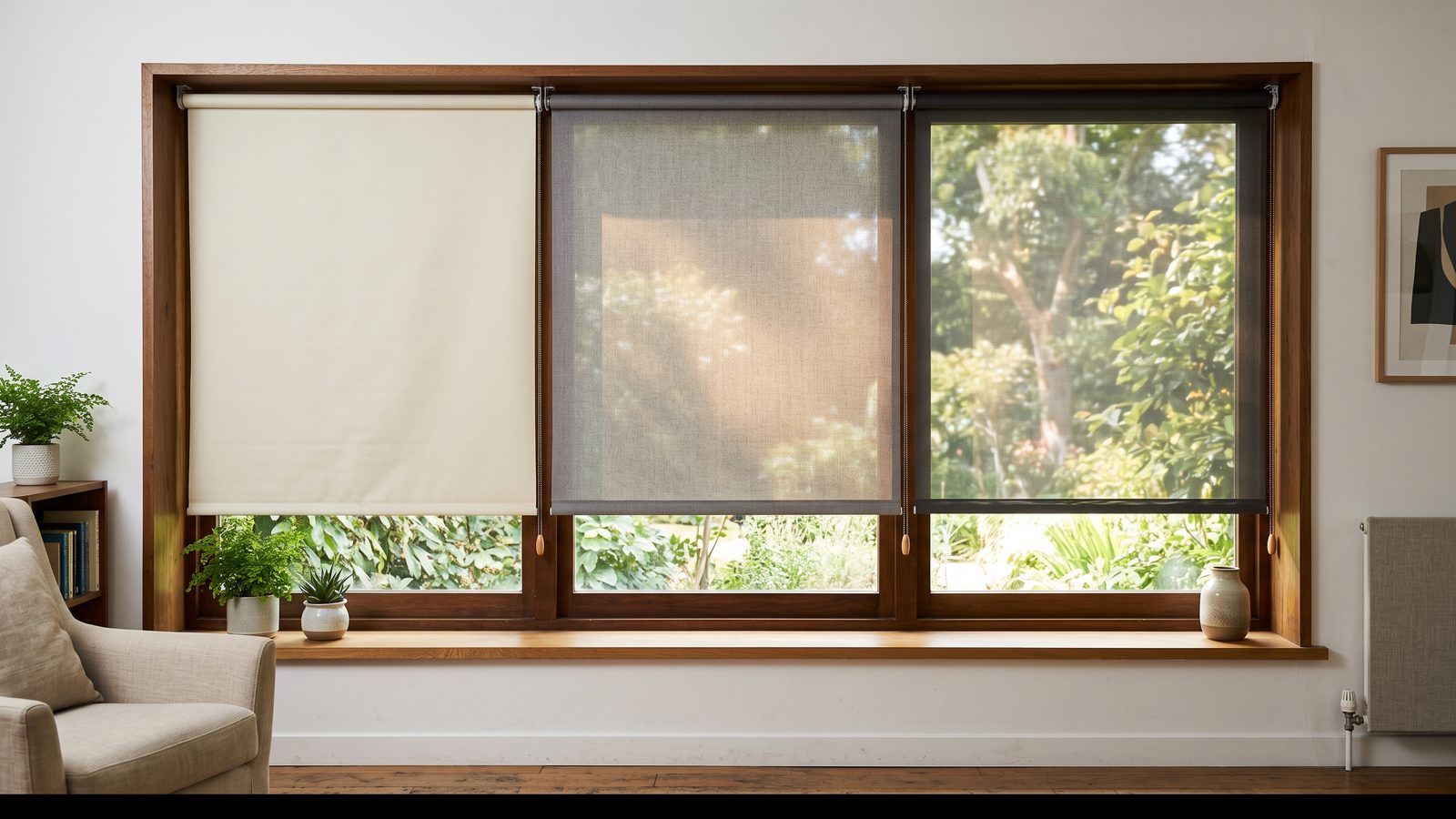
Blockout vs Dim-Out vs Sunscreen Blinds at a Glance
| Sunscreen | Dim-out (translucent) | Blockout | |
|---|---|---|---|
| Light through fabric | Filtered, view retained | Diffused, no view | None |
| Outward view | Yes | No | No |
| Daytime privacy | Moderate | Good | Complete |
| Night-time privacy | None | Silhouettes visible | Complete |
| Glare control | Good | Good | Complete |
| Heat control | Good, especially pale | Moderate | Best, especially with a pale backing |
| Typical room | Living, office, kitchen | Living, dining, bathroom | Bedroom, nursery, media room |
Sunscreen: See Out, Cut Glare
An open-weave fabric specified by its openness factor — 1%, 3%, 5% or 10%. It cuts glare and UV while you keep looking out, which is why it dominates in offices and living rooms with a view. It gives no night-time privacy at all. The weave is explained in full in the openness factor guide.
Dim-Out: Light Without a View
Sometimes called translucent. The fabric is solid but not opaque, so daylight passes through as soft, even light while the view in both directions disappears. It is the middle option and the most common choice for a room that wants brightness and privacy at the same time — a bathroom, a dining room, a street-facing lounge.
Blockout: Genuine Darkness
A blockout fabric is either tightly woven with an opaque backing or a laminate with a solid core. No light passes through the material. It is the only choice where darkness is the point, and it is also the best performer on heat because a blockout with a pale reflective backing turns solar gain away at the glass. The full range sits on the blackout blinds page.
The Blockout Trap: Light Leaks Around, Not Through
Fabric that blocks 100% of light still leaves a 3–5 mm gap each side on a recess-fitted blind, and that gap is what people notice at sunrise. Genuine darkness needs one of three things: a face fit with generous overlap, side channels that trap the fabric edge, or a pelmet closing the top gap. Choosing the fabric is the easy half; the fit does the rest, which is covered in the how to measure for blinds.
Pairing Two Fabrics on One Window
Rooms used day and night often need both. Three ways to do it: a dual roller with sunscreen and blockout on one double bracket, a zebra blind that alternates sheer and opaque bands in a single unit, or a blockout blind behind a curtain. The dual roller gives the truest performance of the three because each fabric is chosen on its own merits.
Frequently Asked Questions
Is blockout the same as blackout?
Yes. They are two names for the same fabric, and South African suppliers use both spellings interchangeably, along with “block out” and “dark out”.
Will a dim-out blind darken a bedroom enough?
No. Dim-out softens light rather than stopping it, and a bedroom with a dim-out blind is still bright at sunrise. For sleep, specify blockout.
Which fabric keeps a room coolest?
Blockout with a pale or metallised backing, because it reflects solar energy before it enters the room. Among fabrics you can see through, a pale sunscreen performs best. The mechanism is set out in the heat control guide.
Get a Free Measure & Quote in Cape Town
Window Blinds Cape Town measures, manufactures and installs across the metro. Call 081 411 8471 for a free on-site measure and quote, or see what blinds cost in Cape Town.