
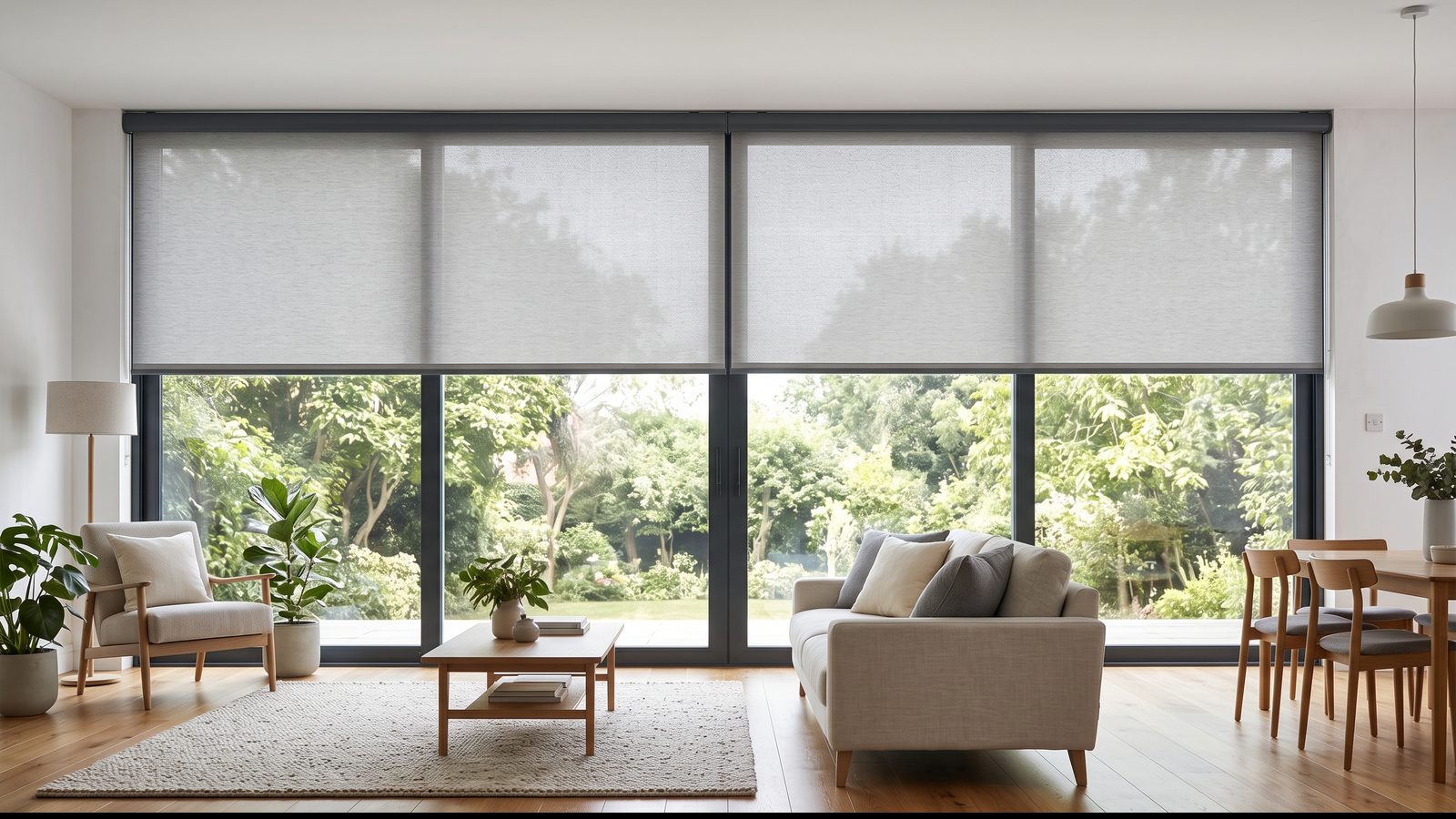
Blinds for large windows stop being a single blind past roughly 2,400 mm wide. Tubes sag, slats bow, and the weight becomes more than a hand mechanism should carry. For big windows and wide windows the fix is splitting the opening into two or three blinds on a shared headrail, so it reads as one but works as several. Free measure and quote — call 081 411 8471.
Blinds for Large Windows: Where Each Type Gives Up
| Type | Comfortable single width | What fails first |
|---|---|---|
| Roller, standard tube | ~2,400 mm | Visible tube sag in the middle |
| Roller, heavy-duty tube | ~2,700 mm | Weight on the clutch |
| Vertical louvre | ~4,000 mm | Track deflection |
| Aluminium venetian 25 mm | ~2,400 mm | Slat bow |
| Faux-wood venetian 50 mm | ~2,100 mm | Weight, then slat bow |
| Basswood venetian 63 mm | ~2,700 mm | Slat bow |
| Roman | ~2,000 mm | Cord strain and uneven folds |
Splitting Without It Looking Split
Two or three blinds sharing one continuous headrail read as a single installation from across the room, and the join lines fall where the eye expects a break. On a 3,600 mm window, two blinds of 1,800 mm each are dramatically better behaved than one 3,600 mm blind, and cost less to repair if something fails.
Weight Is the Argument for Motorisation
A large blockout roller can weigh 8–12 kg. Operating that by chain twice a day wears the clutch, and it is genuinely hard work on a tall drop. Motorisation is not a luxury at this size — it is what keeps the mechanism alive, and it lets several blinds move together on one command. See motorised blind systems for battery versus wired.
Drop Matters As Much As Width
Floor-to-ceiling glass often runs 2,400–3,000 mm tall. At that drop a manual chain becomes a loop long enough to be a hazard, which brings cord safety into it, and the fabric roll on a fully-raised roller becomes thick enough to need a deeper reveal or a face fit.
Heat, Because Large Glass Is Usually West-Facing
The biggest window in a Cape Town house is normally the one facing the view, and the view is often west. That is the worst thermal orientation and the best argument for a dual-sided fabric — pale reflective backing to the glass, dark face to the room. The reasoning is in how blinds cut solar gain.
Frequently Asked Questions
How wide can a single blind be?
Roughly 2,400 mm for a standard roller or 25 mm venetian, about 4,000 mm for verticals. Past those figures the opening should be split into two or three blinds.
Will a wide roller blind sag?
Yes, past about 2,400 mm on a standard tube. A heavy-duty tube buys a few hundred millimetres; beyond that, split it.
Do large blinds need to be motorised?
No, not strictly — but it is strongly worth it. A large blockout roller can weigh over 8 kg, and daily chain operation at that weight is what wears clutches out early.
Get a Free Measure & Quote in Cape Town
Window Blinds Cape Town measures, manufactures and installs across the metro. Call 081 411 8471 for a free on-site measure and quote, or browse the other blind guides.