
Blinds give precise light control, take up almost no wall space and wipe clean, which is why they dominate kitchens, bathrooms and offices. Curtains insulate better, absorb sound and soften a room. The practical answer for most homes is blinds on the functional windows and curtains where warmth and softness matter — and often both on the same window.
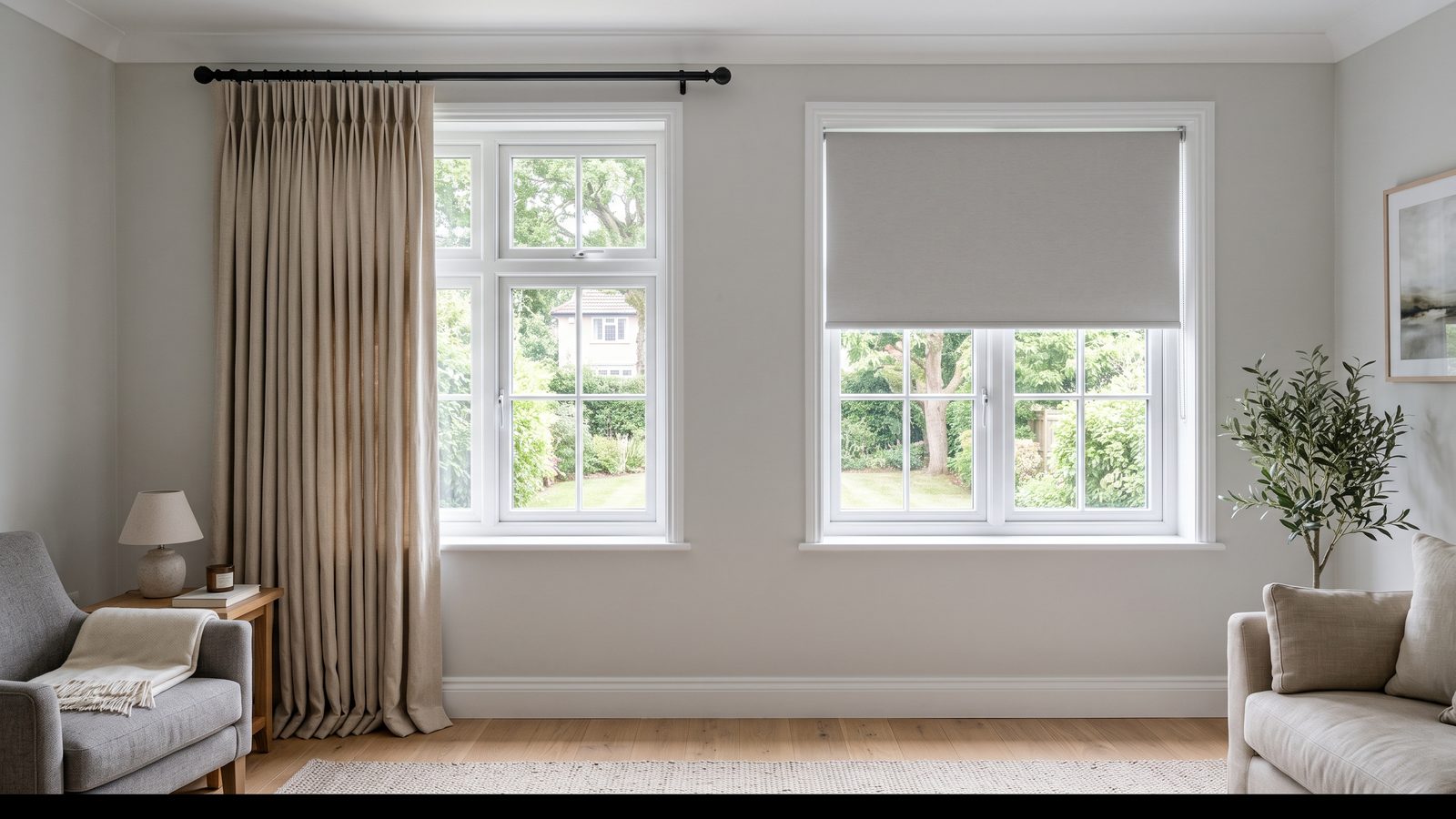
Blinds vs Curtains, Side by Side
| Blinds | Curtains | |
|---|---|---|
| Light control | Precise, adjustable in steps | Open or closed |
| Keeps outward view | Yes, with sunscreen or tilted slats | No |
| Wall and floor space | None | Stack space each side, floor clearance |
| Cleaning | Wipe or dust in place | Take down, wash or dry-clean |
| Moisture tolerance | High with aluminium, faux-wood, PVC | Low; fabric holds damp |
| Insulation | Moderate | Better, especially lined |
| Sound absorption | Low | Good |
| Typical lifespan | 8–15 years | 5–10 years before fabric fatigue |
Where Blinds Clearly Win
Any window where moisture, grease or steam is present. Fabric absorbs all three; aluminium, faux-wood and PVC do not. That covers kitchens, bathrooms, laundries and coastal rooms where salt air is in play. Blinds also win wherever wall space is tight — a curtain needs somewhere to stack, and a blind does not. See kitchen blinds and bathroom blinds for the material specifications.
Where Curtains Still Win
Rooms where you want acoustic softness and thermal mass: a lined curtain traps a deeper layer of still air than a blind sitting a few millimetres off the glass, and heavy fabric measurably damps echo in a hard-surfaced room. Curtains also cover awkward window shapes that a rigid blind cannot follow.
Both on One Window
The most common arrangement in practice, and usually the best: a functional blind at the glass doing the daily light control, with curtains dressing the opening and adding insulation when drawn. A blockout roller behind a decorative curtain gives full darkness without needing blockout curtain lining, and it costs less than lined curtains heavy enough to darken on their own.
On Cost
Made-to-measure blinds and made-to-measure curtains overlap heavily in price, and the comparison depends far more on specification than on category. A basic aluminium venetian is cheaper than almost any made curtain; a wide motorised timber venetian is not. Indicative supplied-and-installed ranges for every blind type are on the blinds prices page.
Frequently Asked Questions
Are blinds cheaper than curtains?
Yes, usually at the entry level — but not necessarily above it. A simple roller or aluminium venetian costs less than made-to-measure lined curtains, but wide timber or motorised blinds can cost considerably more.
Do curtains insulate better than blinds?
Yes. A lined curtain traps a thicker layer of still air than a blind mounted close to the glass, so it performs better on heat retention in winter.
Can you fit blinds and curtains on the same window?
Yes, and it is a common arrangement. The blind is recess fitted at the glass and the curtain face fitted above and outside it, so neither fouls the other.
Get a Free Measure & Quote in Cape Town
Window Blinds Cape Town measures, manufactures and installs across the metro. Call 081 411 8471 for a free on-site measure and quote, or see what blinds cost in Cape Town.
Related: bamboo blinds.