
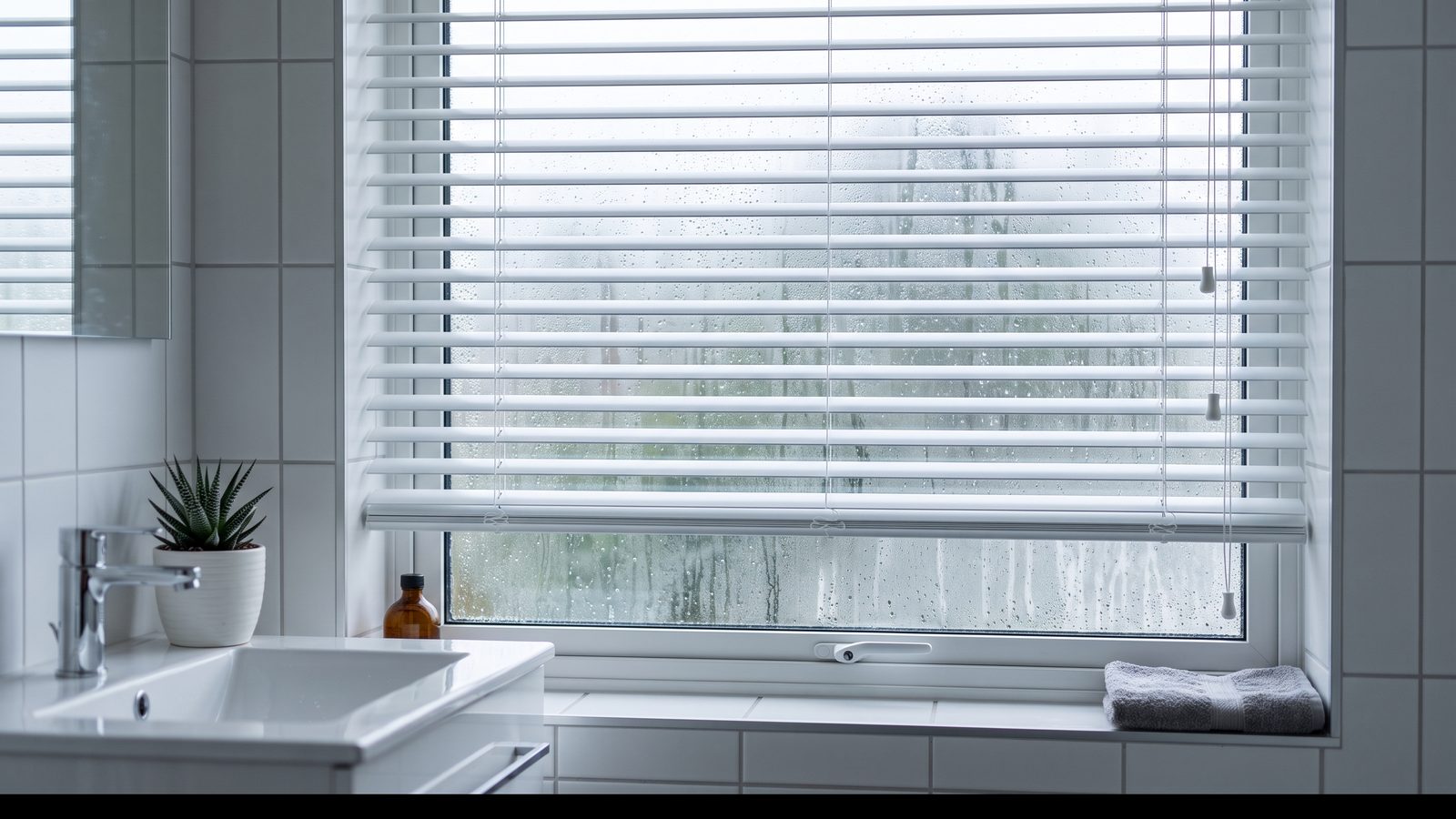
Condensation forms when humid room air meets glass that is below its dew point, and the blind’s role is whether it survives the water, not whether it prevents it. Aluminium and PVC are unaffected; timber and basswood swell and stain; fabric holds the moisture long enough for mould to establish. This is why 25 mm aluminium venetians are the standard bathroom specification rather than 50 mm basswood.
Where the Water Comes From
Warm indoor air holds far more moisture than cold air. When it touches glass at 10°C on a Cape winter night it drops below dew point and releases that moisture onto the pane. A closed blind traps a still, humid layer between fabric and glass — ideal conditions for mould on anything organic. Showers, cooking and drying laundry indoors are the three biggest moisture sources.
Mould Resistant Blinds, Ranked by How They Cope
| Material | Risk | Recovers from a wetting? |
|---|---|---|
| Solid PVC / vinyl | Lowest | Yes — wipe and dry |
| Aluminium | Lowest | Yes — wipe and dry |
| Faux-wood | Low | Yes, if dried promptly |
| PVC-coated fabric | Moderate | Usually |
| Uncoated polyester | High | Rarely — staining persists |
| Real timber | High | No — swells and lifts finish |
| Natural weave / bamboo | Highest | No — fibre holds spores |
Once Fabric Has Mould, It Is Usually Done
Surface mould on aluminium or PVC wipes off with a mild soap solution and a proper dry. On fabric, by the time it is visible the growth has rooted into the fibre; bleaching removes the colour but not the organism, and it returns. That is a replacement, not a clean. Material-by-material care is in how to clean blinds.
What Actually Prevents It
Mould resistant blinds for a bathroom are simply blinds made of something mould cannot feed on — aluminium, solid PVC or faux-wood.
- Ventilate after moisture events. Ten minutes of open window after a shower removes more water than any blind change.
- Raise the blind during the day. A permanently lowered blind in a damp room never dries out.
- Leave an air gap. A blind held hard against the glass by side channels traps more moisture than one hanging free — worth knowing before specifying channels in a bathroom.
- Choose the right material from the start. In a bathroom that means aluminium, PVC or faux-wood: bathroom blinds.
Coastal Cape Town
Sea air carries both moisture and salt. Salt is hygroscopic — it pulls water out of the air and holds it — so a coastal blind stays damp longer than the same blind inland. Rust-resistant hardware and non-organic materials matter more here: aluminium blinds.
Frequently Asked Questions
Can mouldy blinds be cleaned?
Yes on aluminium and PVC — wipe with mild soap and dry thoroughly. On fabric, no; by the time it is visible it has rooted into the fibre and will return.
Do blinds cause condensation?
No. Condensation forms on cold glass regardless. A closed blind traps the humid layer against the pane, which makes the consequences worse but is not the cause.
Which blinds are best for a damp room?
Aluminium or solid PVC. Neither is organic, so there is nothing for mould to feed on, and both survive being wiped down repeatedly.
Get a Free Measure & Quote in Cape Town
Window Blinds Cape Town measures, manufactures and installs across the metro. Call 081 411 8471 for a free on-site measure and quote, or browse the other blind guides.